Q&A with Donyae: Meet our Fat Liberation Month Artist
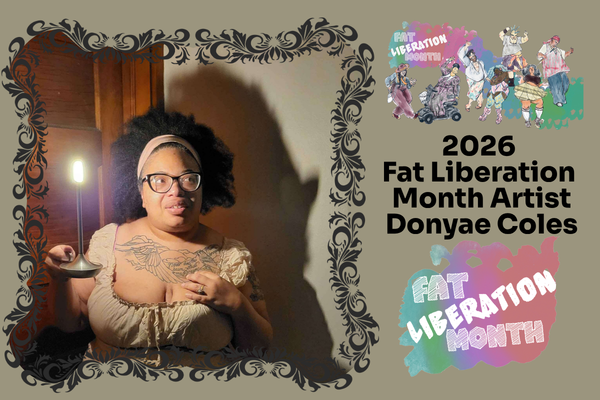
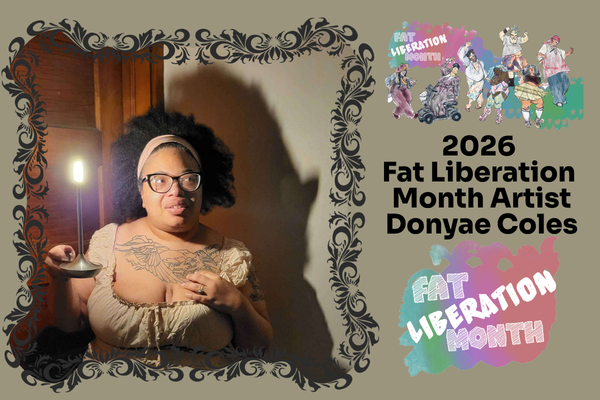
[Accessibility description: A photo of Donyae Coles holding a candle while standing in front of a door, her shadow cast against the wall from the light of the candle. The Fat Liberation Month logo and artwork, created by Donyae, is also included along with the text: “2026 Fat Liberation Month Artist Donyae Coles.”]
Throughout this month, you’ve seen a series of endearing fat folks dance across our Fat Liberation Month posts and mailings. Now it’s time to learn more about Donyae Coles, the artist behind our 2026 Fat Liberation Month art and logo. Love the images Donyae created for us this year? Make a one-time donation to NAAFA or join the NAAFA POD by September 15 at naafa.org/give, and we’ll send you an exclusive thank you sticker featuring Donya’s FLM characters!
Here’s our interview with Donyae. Learn more about Donyae at donyaecoles.com.
Do you identify as fat, and what has this meant to you as part of your identity? What has it meant to you as an artist?
I am fat! My journey from fat acceptance to fat liberation actually influenced my art A LOT. If you go back and look at my older pieces, you’d see no fat bodies because that’s just … not what you’re “supposed” to draw. The fat body is an oddity, a study in form. Not the art. And when it is The Art, it’s more of a commentary than an observation. Fat bodies aren’t allowed to just be.
When I started to really move through acceptance into liberation, that question started to push at me, too. If I am ok with my body, if I see nothing wrong with my body, if these are truths of me and my body, then why is this not reflected in my art? Why do I not paint and draw bodies like mine? Why is the art thin?
Confronting that question really helped to form what I was approaching in my art. I knew I was trying to do something, to communicate something, but I didn’t know what until I really started to think about my sense of self. I began to make art about being in a body. Existing while fat and Black and femme and poor.
And in that process I started to really see lack of representation at all levels in communicating this experience. Because there are no references for the fat body. There are more now than there were when I started to paint twenty years ago, but even now, there’s a lack. And this fed back into really understanding all the places and all the ways that people like me just…weren’t there in the record.
For my personal identity, it has really been about confronting who I am and what that actually means versus what I’ve been taught it means. Examining what it means to be fat, in a practical, real sense of being in my own body with my own feelings, excising the beliefs that were placed there to shame and control me and seeing what is left and what it means for me, as the person who carries myself, has been a freeing and life-changing experience.
Do you identify as an activist? Do you consider your art to be a form of activism? Do you think of your art as political?
I exist as a fat, Black, queer disabled femme. Everything about me is political ,and that’s before you even get into the art. I do consider my art, both visual and written, to be a form of activism.
I actually used to do a lot of writing around activism, fat activism, and race, especially back when that kind of writing was popular, before…the times we live in. And that was more unambiguous and educational. I spent a lot of time explaining things and educating people with my work.
My art is a different type of communication. The themes I deal with in my visual art are about moving through the world with this body, about how various aspects of oppression impact that experience.
What does fat liberation mean to you?
Freedom from the cultural oppression forced upon fat bodies. Freedom from the marginalization and violence of oppression forced upon the fat body. Freedom to be. Freedom.
You're known as a horror writer, and you also create a lot of art using horror themes. What draws you to horror in your creative work? What are other subjects or themes your work takes on?
I’ve always been a creepy kid, a gore gore girl if you will. But the thing about my work, especially my visual art, is I don’t think about it as “horror”. I mean, my debut novel, Midnight Rooms, started off as a romance novel, but during the drafting I realized I had something else I wanted to talk about with my work. I like horror; I’m a reader and watcher of it! But with my work it’s less about creating within the genre than it is that the genre is a tool to communicate what I am trying to express.
With my visual art, I’m not reaching for those motifs as a way upset and disturb. I use those motifs to express the way that these oppressive forces can feel and the way that they pervert our reality. It is also a way to move within ideas of otherness and play with a label that is often applied to non-compliant body-minds. I think the first impulse with my work is to focus on the grotesque, but I am using the grotesque because that is how they see us, and I am shaping my own image.
The other themes that I am exploring are a lot to do with poverty and space as it is determined by the body and resources.
But even so, I don’t think of my work as horror work because what I am actually exploring is joy. I am depicting a sort of mad-joy despite the monstrous and the violence. A relentless sort of hope and community that survives despite it all. That it doesn’t matter how you see us. We are still here, we are still laughing, we are still beautiful.
The art you created for NAAFA is a bit of a departure from the visual art you are best known for today. What inspired the characters you created for NAAFA?
It’s funny because it’s actually not a departure! My daughter was JUST lecturing me about putting more of my not-masterwork out there because it’s all illustrative. My first paintings when I really started painting were actually a smiling sun and moon for my children’s rooms.
I contain multitudes lol.
I wanted to do something joyful, and I wanted to showcase fat people in ways that I don’t often see them both in movement and clothing choices. So I thought, what’s more joyful than dancing? I also knew I wanted to do some different fashion choices for a wide array of people and then just went from there!
![[Accessibility Description: This banner features whimsical watercolor artwork by Donyae Coles showing fat people of various shapes, sizes, skin colors, and hair colors celebrating Fat Liberation Month.]](https://images.squarespace-cdn.com/content/v1/5e7be2c55ceb261b71eadde2/a607dc3c-2a1d-4338-8ff5-93f6a7cadca4/Banner+FLM_Donyae+Coles.jpg)
[Accessibility Description: This banner features whimsical watercolor artwork by Donyae Coles showing fat people of various shapes, sizes, skin colors, and hair colors celebrating Fat Liberation Month.]
I’m not an artist that does a lot of thumbnails and sketches. I get an idea and I shape it as I go. And this was no different. It started with a two part idea, dancing and fashion, and then I just let it build out from there, chasing down looks that I thought were interesting. Deciding on the look and then the movement to follow. It was very organic.
The logo was the harder part! Not because I hadn’t done that type of work before but because every character was different – which was my goal! But it still made deciding how to approach that a little tricky.
What's on the horizon for you? Any upcoming projects you want to share about or promote?
I have a new book coming out! It’s called The Sunken, The Adored. It is another Gothic horror, this time about queer community. It drops August 25!
Is there anything you never get asked about your art that you really wish people would ask you? Tell us anything else you want our audience to know about Donyae the artist or Donyae the person.
Gosh, really put me on the spot here! You already asked me such good questions and I told you a lot about me and my process already. But nobody ever asks me about my hobbies! I started tapestry weaving again, and I’m really excited about that!