Meet our 2026 Scholarship Award Winners
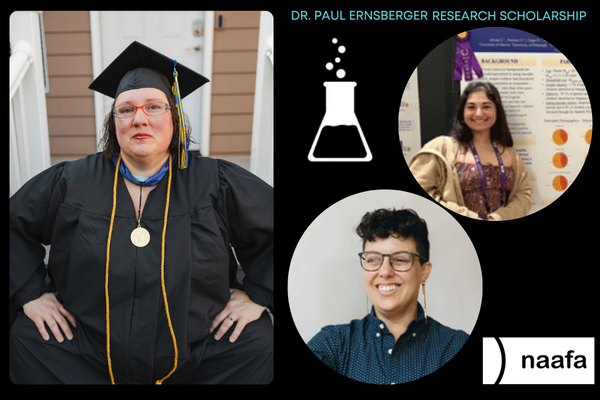
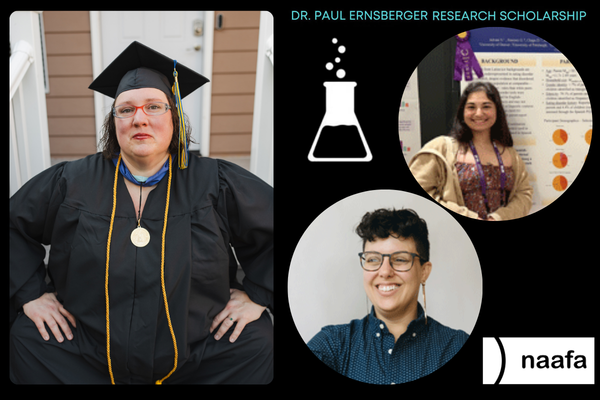
[Accessibility description: A photo collage of the three winners of the 2026 Paul Ernsberger Research Scholarship.]
The Dr. Paul Ernsberger Research Scholarship was established to not only honor Dr. Ernsberger’s decades of research on metabolic syndrome, diabetes, weight cycling, and medical harm caused by diet obsession and weight bias. It was implemented to continue debunking myths and misunderstanding about fat and health. With these scholarships, NAAFA helps support graduate students who want to carry on and advance Dr. Ernsberger's legacy. These scholarships are funded by you, our donors. If you believe it’s important to fund future research, you can donate to the scholarship fund at naafa.org/donate.
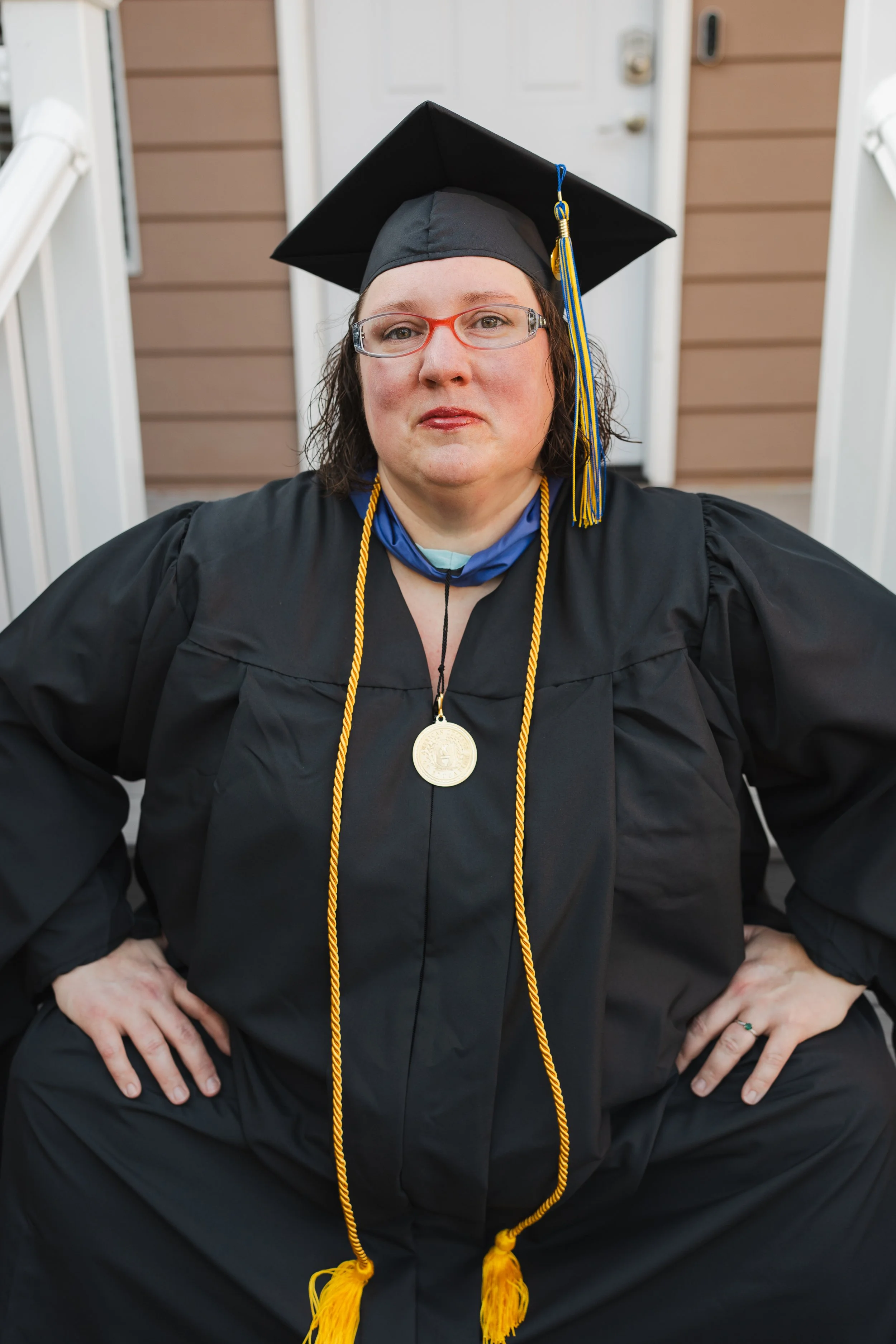
[Accessibility description (provided by the person pictured): A white woman with curly brown hair to her shoulders and pink and grey square glasses sits on white steps with white railings outside a brown home. Her hands are on her hips and she is smiling with closed lips. She wears Masters degree regalia including a black gown with oxford sleeves and a four-sided tam with a yellow and blue tassel, a light blue hood indicating a Masters in Education and a gold cord indicating an Honors graduate. There is a white door in the background. Photo by Lindley Ashline.]
Ragen Chastain (she/her) - Awarded $2,500 Scholarship
Ragen is a PhD candidate in the Department of Health Education at the American College of Education. Her dissertation is Resource Deficits and Nurses’ Attitudes Toward Higher-Weight Patients: A Quantitative, Quasi-Experimental Study of Registered Nurses Providing Direct Hospital Care. Decades of research shows that weight bias among nurses is pervasive, from a general dislike of fat patients to a stated desire not to treat or even touch them. Over the past 17 years educating healthcare providers about best practices to care for fat patients, nurses have frequently described to Ragen that caring for fat patients in environments in which the lack of needed resources, particularly adequate staffing ratios and high-weight rated Hoyer lifts, causes them to experience both acute and chronic pain. Ragen’s current hypothesis is that they direct the blame for this not toward the resource deficit, but toward their fat patients. This study will investigate the possible impacts of resource deficits around high-weight-rated Hoyer lifts and adequate staffing on registered nurses providing direct care to adults in hospitals. Ragen currently teaches nurses dealing with these resource deficits to focus their anger on the systemic weight stigma that is harming both them and their fat patients, and to work to correct it. If, as is hypothesized, weight bias is being driven by resource constraints, then the results of this study will be used to educate healthcare leaders and support nurses and other healthcare workers in addressing and resolving these constraints to improve nurse experiences and patient outcomes.
Ragen stated, "I have been privileged to educate and train thousands of healthcare professionals at some of the most prestigious healthcare organizations in the world including Memorial Sloan Kettering, Massachusetts General Hospital, and the Yale School of Medicine, as well as create resources that are used by both clinical and lay audiences. I have seen firsthand how this work can create change. Still, there are doors that are not open to me without a doctorate. My pursuit of this degree goes beyond the ability to add new research to my field, though that is an important aspect. On a larger scale, my doctorate will expand my reach and my impact in ways that will increase my ability to carry on Dr. Ernsberger’s incredible legacy, using a fat positive lens and a blend of research, advocacy, and science to help create a healthcare system, and a world, where fat people are accepted, included, accommodated, and can thrive."

[Accessibility description (provided by the person pictured): A young brown woman stands smiling in front of a research poster presentation at a conference. She has long, dark hair and is wearing a floral dress, a beige cardigan, and a conference lanyard with badges. She is holding a canvas tote bag. Behind her, the main poster is titled "Validation of the Spanish Version of the Parent Eating Disorder Examination Questionnaire." The poster displays sections labeled Background, Participants, Results, and Conclusions, and includes multiple charts and statistical tables. A purple ribbon labeled "Best of Show" is pinned to the top of the poster. The University of Denver and other academic institutions are listed as affiliations. Two additional posters are partially visible on either side, labeled #38 and #39.]
Shikha Advani (she/her) - Awarded $1,250 Scholarship
Shikha is a PhD candidate in the Department of Social Work at the University of Denver. Her project for "We Deserve Space" is a weight-inclusive community-based intersectional intervention for higher weight individuals to reduce internalized weight stigma and improve mental and behavioral health outcomes. It's a large scale (682 individuals) well-run study and looks to yield important findings that can improve fat folks' experience with weight stigma and hopefully lead to improved physiological and mental health.
![[Image description (provided by the person pictured): Photo of Hillary Hecht wearing a dark blue button down shirt and glasses, leaning on a stack of books, and smiling.]](https://images.squarespace-cdn.com/content/v1/5e7be2c55ceb261b71eadde2/74adeefd-21c9-4b77-b9bd-8747fa22e1a6/Hillary-Hecht.png)
[Accessibility description (provided by the person pictured): Photo of Hillary Hecht wearing a dark blue button down shirt and glasses, leaning on a stack of books, and smiling.]
Hillary Hecht (they/them/theirs) - Awarded $1,250 Scholarship
Hillary is receiving a third scholarship (original award in 2024). They are driven to reach all aspects of their goals in addition to lending themselves to multiple research and educational endeavors all while finishing their doctorate. They function well in teams whether leading, facilitating, or even in just engaging other team members to bring their voices forward. They are not afraid to professionally and humbly debunk fellow peers and faculty members' misunderstandings about the relationship between size and health. Per one of the reviewers, they gently offer ways to spotlight inclusivity in teaching and research.